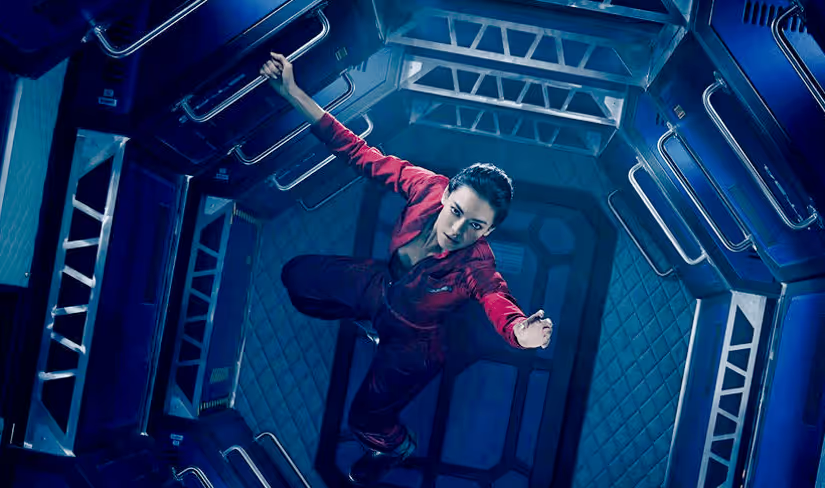
The journey is not over for fans of The Expanse. Thanks in part to the #SaveTheExpanse push, Amazon Prime Video has picked up the series for Season 4, which means a bigger budget and no time restrictions on the episodes. Woot!
While we wait for the new Season 4 on Amazon Prime, let’s look back at the first three seasons, which aired on SyFy and are now available on Blu-ray or via digital streaming services like Vudu (or Amazon, of course). For those not familiar with the show, the story is set two hundred years in the future. Mars is colonized, and so are a few asteroids. Earth is still part of the equation, too. Those three factions (Mars, The Belt, and Earth) are in competition and don’t exactly get along, but the discovery of an extraterrestrial lifeform changes everything.
A Sound Effect talks with award-winning supervising sound editor Nelson Ferreira of Sound Dogs, Inc. in Toronto who has been with The Expanse from the start. He’s joined by award-winning sound designer Dave Rose, who started the show with Season 2. They discuss the science behind the show’s sound, and share specific details on how they created the sound of the mag boots, the comms, the weapons and tech, and much more!
How has the sound of The Expanse evolved over the years?
David Rose (DR): One change was in sound designers. I’m the second sound designer on the show. The first season started off with sound designer Nathan Robitaille but the show changed direction after that for Season 2.
Nelson Ferreira (NF): Within the context of the first season, we were creating a template for what the show would sound like. Everyone approached it from the position of scientific accuracy, like there’s no sound in space. A big reference was the film Gravity. We got some ideas as to approach from it. We looked at the film Prometheus as well. It was very ambitious.
But then once Nathan got into designing the first few episodes with the producers, we realized the show was going more in the sci-fi direction of Star Wars. It became really polished, high-end sci-fi instead of a harsh, ultra-realistic approach. So as we went through the first season, both the show and the sound became more and more developed along those lines.
When Nathan moved on from the project and Dave took over, fortunately there was a change of direction in the show anyway. There were some ships and locations that carried over, but there were also many new worlds and environments and tech that Dave could make his own, which he did at the start of Season 2.
[tweet_box]How The Expanse’s futuristic sound is made[/tweet_box]
DR: When I started on the show, one thing I wanted to change was the ultra-realistic space style that had evolved through Season 1. At times, it worked well, particularly in the controlled environments, like when the actors are working outside the ship. But once you got into a space battle, with weapons firing and space ships flying, I felt it really needed a bigger, brighter sound. So that was one thing we all decided to be heavier with right off the bat — to make space bigger, louder, and more in your face.
Often a beep might be telling the audience what to pay attention to and it was necessary to have those sounds play a more prominent role.
Other sounds just evolved naturally, like the sounds of the smaller tech and the user interfaces. The first season kept the UI sounds to a bare minimum but as we got further into the show, we realized that we needed the UI sounds because a UI beep would be a story point. Often a beep might be telling the audience what to pay attention to and it was necessary to have those sounds play a more prominent role than was the case in Season 1.
In terms of weapons, we’ve pretty much stuck with the template that Nathan built. But as for the ships, those have gotten bigger and louder, and brighter as well.
NF: A big part of the show (and a big part of the novels this is based on) is that the story is set in the future but it’s the near future — only a few hundred years from now. Much of the technology has carried over. So it’s low-tech from a 21st century standpoint. It’s still connected, in a way, to the technology of today. For example, the weapons are still ballistic in nature. There are still bullets coming out.
DR: Generally, we’ll start any of the tech design with something that we auditorily understand. We don’t do a lot of synth-based work. We typically start with a real sound, like a real gun sound. That’s the starting point. Then we have to figure out how to take that real sound and just twist it a little bit so it sounds off. We’ll add a bit of servos that you wouldn’t hear on a real gun. We’ll manipulate the bullet sounds so that they sound extra fast — just so the audience recognizes that it’s a gunshot but it’s a bit different.
NF: When Dave has had to make adjustments to a sound, the direction is usually, “Can we low-tech it a little,” as opposed to futurizing it more. I don’t think we’re ever asked to make something sound more high-tech. The direction is always to bring it back toward the 23rd century which tends to make things seem more real.
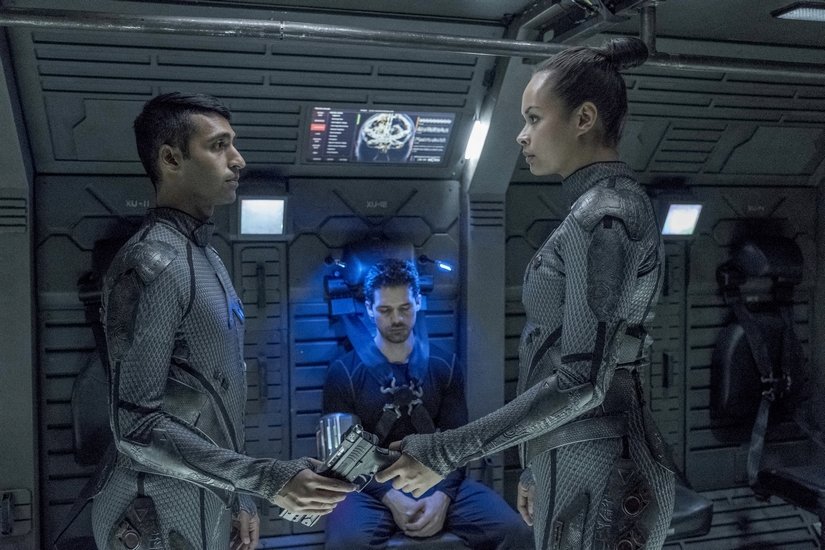
There are three main factions: The Belters, whose tech is more duct tape and glue in comparison to the Mars faction, who are the most advanced. Then there’s Earth, which is somewhere between the other two. Does the technological advancement of each faction impact the sounds of their tech?
DR: It factors in a lot, actually. For the Earth sounds, I try to make them extra big, with more bass so it sounds thick and imposing. The Mars sounds tend to be cleaner and higher-tech, sharp and precise. Nothing creaks on a Mars ship. All the servo sounds are nice and tight and clear. The Belt sounds are always a bit broken, as though things aren’t quite working right. If there’s a door opening, then there might be something broken with the mechanism. So, their advancements in technology definitely impact the sounds of their tech.
The near-future science of the show is really sold through the sounds of the tech. It’s both heavy and metallic (like the ships’ sounds and even the magnet boots) but also light and synthy (like the control panels and also the medical bandages). Can you talk about your approach to those sounds, particularly the mag boots?
DR: The magnet boots were one of the first things that were designed right from the beginning of the show. It went through quite a lot of iterations. At one point there were 15 different tracks of boots, with chuffs and servos and clinks. We had to whittle it down into something that we could use consistently. It actually continues to be one of the more challenging sounds on the show, especially going into the third season. We have to make it feel organic and play, so that it doesn’t sound like a repetitive sample.
NF: A question that always comes up is — “Are we under thrust here or not?” Because when the ship is under thrust then there’s gravity. If not, then the boots are engaged.
DR: Everything in the show is made of metal. Whenever we are in doubt, we put in a metallic sound. If we are talking to, Steve Baine, our Foley artist and he’s questioning me about a particular surface and I’m not sure exactly what it is, I can almost guarantee that we’re going to want it to sound like metal.
There is very little plastic and there are no organic materials except on certain parts of Earth.
Are the mag boots covered in Foley, or do you cut that with effects? How do you keep it from becoming repetitive?
DR: For the first season, one of our sound effects editors, Tyler Whitham, built a Battery instrument for Native Instruments Komplete. It has hundreds of slight variations of the boot sounds. Then the Foley team does their regular work with the footsteps and we get that track and use it to trigger the mag boots sounds in Battery. Often we use the Foley footstep along with the click of the boot as it engages. Knowing how many footsteps there were going to be with these mag boots, we knew there was no way we could cut each one individually.
NF: So, to a degree, the effects portion is automated based on where the Foley footsteps have been performed.
DR: Then our re-recording mixer on effects, Kirk Lynds, has the challenge of blending the two together and making them sound seamless. He has the challenge of building in the perspectives, as they’re running down a hallway, coming toward you and then going away.
It can get very complicated when there are a lot of people in the scene and they all have their mag boots on. … We have to pare that back and focus on certain characters in the scene.
It can get very complicated when there are a lot of people in the scene and they all have their mag boots on. We have to be careful about which ones we feature otherwise it becomes a cacophony of clicks. If six people are running at the same time, it could sound quite ridiculous. So we have to pare that back and focus on certain characters in the scene. We have to be deliberate about not playing all the mag boots otherwise it would sound silly. So, that’s definitely one of our more difficult sounds to work with, even at this point.
Were the showrunners very hands-on with defining the sound of the show’s tech?
DR: I have to say that Naren Shankar (the showrunner) is quite involved with many aspects of sound. I spend a lot of time previewing stuff for him before getting to the mix, even in early stages of edits, I’m sending him sounds and getting his feedback. So those big, recurring story sounds he has had a hand in how all that works.
NF: He’s got a substantial scientific background in terms of his education.
DR: He has a PhD in Applied Physics and Engineering.
NF: He has experience on Star Trek: The Next Generation and also on CSI and is a hands-on, really effective showrunner. He’s got an idea about pretty much everything and so much of it has a basis in real technology and real science and it’s not just imagined. So he can give very clear indications of what he’s looking for and the science that is behind it.
DR: That informs all aspects of the show. For VFX, it plays into the motions of the ships and what they can physically do without being torn apart. It factors into the Martian suits and their tech, into the design of the whole show really. It comes down to real science and that’s one of the strengths of the show. If you read the Reddit feedback, I think people really appreciate that about the show. It kind of sets it apart from other sci-fi series.
NF: It makes it real and it makes you want this world to exist because it’s been crafted so realistically.


What about the protomolecule? How did you create the sound for this ‘lifeform’?
NF: The protomolecule started in Season 1, but it was basically on the cellular level. It was controlled, to a point, on a laboratory level. It was a virus for lack of a better term. It was still very small in scale and contained. When Dave took over for Season 2, that’s when the protomolecule became much larger and a truly intelligent life form.
DR: It started out as a small virus, like an infection. No one was sure about what it was. It was definitely organic in nature but it had a crystalline feel to it that informed the initial design. Then when we got Season 2, in particular Ep. 5 when Miller (Thomas Jane) goes onto Eros and the entire asteroid is infected. There are these firefly-like things flying around. Then the protomolecule is speaking to him through Julie Mao (Florence Faivre) and it’s controlling the entire asteroid. For that, we had to take the sound way up and figure out how to make that work.
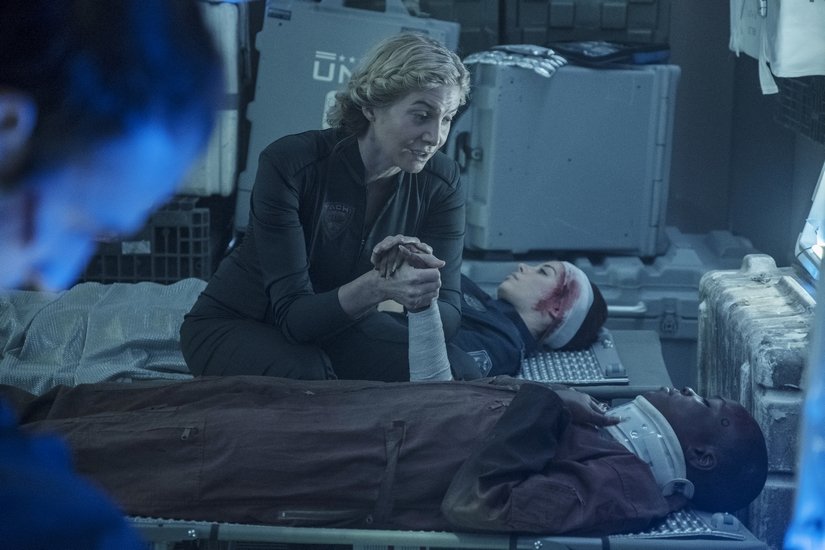
NF: In Season 3, we get into the protomolecule hybrids. The character Katoa (Jaeden Noel) becomes a protomolecule/human hybrid. There we had to give it a voice. And the voice has that crystalline quality to it but at the same time it’s still a person.
DR: That was an interesting development. At the end of Season 2 we had a hybrid, but it was so far gone that it couldn’t speak. It didn’t have as much of a human aspect to it as Katoa did. For that first hybrid, Naren and I tried a few iterations where we gave it a vocalization, but we found that it wasn’t working at all. So we focused much more on the movements. I had to come up with a way of using the original protomolecule sounds to create movement sounds for the hybrid. So every arm movement and head movement, we had an original sound for. We also focused on the heaviness of the footsteps on the ship to make it feel grounded and solid.
In Season 3, we have that shift in Katoa where he starts off with just a bit of protomolecule seen in his arm but then it fully takes him over. We had to come up with a voice treatment for him. It was dialogue re-recording mixer Steve Foster who came up with the version of how we would play that.
Where did you start with the protomolecule? What real sounds did you start with for that? How did you evolve the protomolecule into its various stages of existence?
DR: We started with electrical buzzing sounds and then we moved into ice sounds. I think I was inspired by the crystalline nature of the protomolecule visuals. So we were crunching ice in different ways, squeezing it and trying to crack it.
By the time we got to S2, Ep. 5, I was dealing with more vocal treatments for the protomolecule. We recorded a lot of loop groupers saying random things in Belter dialect and in English and then melded that with the electrical sounds and the ice sounds and we had those stuttering and twisting and flying around the room as those voices were flying around on Eros.
How did you turn electricity and ice into movement sounds? How did you use those to create that vocal treatment specifically?
DR: We went down a lot of paths, trying vocoders and morphing plug-ins on the voice to give it a crackly feel. When the protomolecule is in a smaller state, you hear this crunch to it, which Naren seemed to like. So we had to get that crunch into the voice.
The challenge when you’re trying to add an effect to a voice is somehow to make it feel like part of the voice and not just an effect on top of it.
NF: I tried a vocal treatment that was similar to the way that we processed the deep space comms. The challenge when you’re trying to add an effect to a voice is somehow to make it feel like part of the voice and not just an effect on top of it. Naren gave me an idea— again by describing the science and physiology behind it. He explained that Katoa’s windpipe is becoming crystallized and his lungs are filled with these crystals and it’s not working like a human mechanism anymore.
The key is to start with a clean, highest-resolution-possible version of the voice. We re-recorded all of the lines for Katoa so that we had a nice, robust recording to use. I used iZotope’s noise reduction but instead of outputting the signal of the clean voice, I did the opposite. I output the signal of the noise only. As I increased the amount of noise reduction, it would start to introduce digital artifacts into the voice. It added certain frequencies and the more percussive syllables started popping through. It gave it this intermittent, crackly kind of effect. So that was the starting point for the effect. Then, I turned the vocals over to dialogue re-recording mixer Steve Foster who put the sounds in the creature’s mouth and pushed the overdrive on Katoa with his performance. It reached a point where we were looking at each other and asking, “Is that too abrasive?” You get used to hearing something for awhile and it tends to feel dulled-down. But in the end, it was a success because when we played it for Naren he liked it.
Like so many things on the show, it came down to a discussion that we had in the room, bouncing ideas off of each other. What should it sound like? What would the producers like? What is something else that we can bring to it? Everyone throws in ideas to get to where we need to be.
DR: It’s a very collaborative crew. It’s very small (on the mix stage it’s Nelson and I, plus the mixers Steve and Kirk) and we are constantly bouncing ideas off each other and working it out as we go.
NF: This is a show where we are given the chance to mix it our way. Naren is usually around only for the first couple of mixes and then he’s back in Los Angeles until they wrap picture. So we work remotely for much of the process and are allowed to make it our own and present it to them. It’s become quite a joyous process.
DR: Naren likes to hear something new, especially at the mixes. I work on a lot of bigger elements that we will preview for him before we start the mix but still for many elements he is hearing them for the first time. During picture edit, they aren’t spending a lot of time working with sound. The editors have a library of sounds that we already created for the show, but they don’t spend a lot of time working with sound. So when we get to the mix, Naren is often hearing the episode for the first time and he’s into that. He doesn’t have temp love.
NF: It’s always, “Make it cooler.” For every department on the show, that’s the answer, to make it cooler somehow.
DR: You’ll find that from anyone on the show — from the visual effects team and the set designers right on through to everyone involved. Basically the mandate that is coming down from Naren is to see how much further we can take it.
The protomolecule eventually grows into this massive ring, which is essentially a gateway to other places in the universe. It’s amazing that you have taken a sound for something that started on a cellular level and have modified it to become a sound for something that exists on an epic scale…
NF: Yeah, it’s like, how much bigger can this thing get? The ring is the size of a planet.
Did you get to do any fun field recording for the show?
DR: I wouldn’t say that we do a ton of recording. Mostly the sounds I record will be for the smaller tech sounds. I have a microphone next to me while I’m cutting the effects and I might go off and record little servos and toys. I use a lot of kids toys for the smaller tech.
I got a response from a great sound effects recordist, Stéphane “Fufa” Dufour, of Articulated Sounds. He’d gone to a Formula E race … and recorded a whole series of sounds … So that was the basis of the Razorback.
The bigger sounds, like the ships, those tend to be based in modified vehicle sounds. We did the Razorback ship sound last year and I was struggling to come up with something interesting. The post production supervisor, Gary Mueller, mentioned that he had seen a Formula E race, which is the electric version of Formula One. I started watching YouTube videos on it, and my god, it’s so cool. This was about a week before the mix, so I put out a call on Facebook and got a response from a great sound effects recordist, Stéphane “Fufa” Dufour, of Articulated Sounds. He’d gone to a Formula E race in Montréal a month or two before that and recorded a whole series of sounds that he sent to me. So that was the basis of the Razorback. His sounds were really helpful especially so late in the process as I was trying to come up with what the ship should sound like.
What are some of your go-to audio tools on The Expanse?
DR: My go-to tech is Native Instruments Reaktor. I don’t build synths in it, but I download patches from other people. I like to use it specifically for granular synthesis. I like to take sounds that I’ve already recorded or sourced from my library and then use Reaktor to come up with something surprising. I used a lot of patches in Reaktor to distort the voices on Eros, to create stutters and stops and changes. There’s a Whoosh plug-in for Reaktor that I use a ton for pass-bys and things of that nature. That’s been a great tool on this show.
I also use plug-ins by GRM Tools to take normal sounds and make them sound just a little bit different. I used GRM Tools a lot for designing the bullet pass bys, to add those little zips to the end of the bullet sounds. I start with a real bullet sound and then I use GRM Tools to bend specific frequencies in weird ways so that the shot doesn’t sound straight ballistic. It sounds slightly odd, with twists and turns in it.
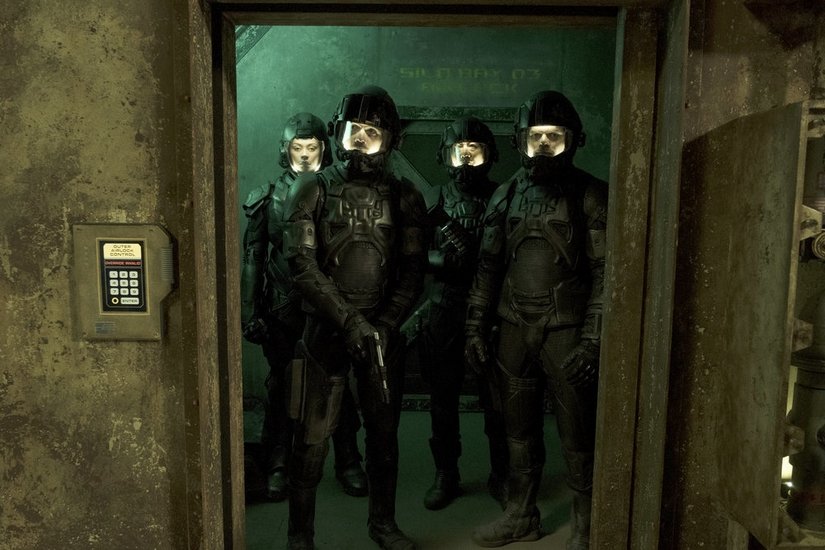
Audio Ease’s Altiverb gets used a lot, especially on the mix stage for doing the treatment for the helmets. For the space helmets, Nelson recorded an impulse response from inside the actual helmets that they use on-set. We knew we’d be doing a lot of ADR for the helmet dialogue because the helmets have little fans in them to keep the actors cool because they are sealed inside that suit. It gets pretty hot in those helmets and stuffy and loud. You have these little fans whining away through the dialogue track. So we end up looping a lot of those lines.
Naren likes the whine of the fan a little bit because it adds to the realness of the helmet dialogue. So even though we loop those lines, we add a hint of the fan whine back into the clean ADR.
NF: That adds to the feeling of a ‘low-tech,’ 23rd century feel.
Recently, they’ve taken a page from Gravity and they’ve started to paint-in a lot of the shields on the helmets. So they’ll shoot the scene without the face masks on and then they’ll paint those on in VFX. But, there are still a lot of scenes they can’t do that on, for logistical reasons. So they’ll shoot it with the helmet shield on and I will evaluate it to see if we need ADR.
If we do ADR, we will apply the helmet impulse response to give it a nice, tubby feel. If the line is coming through a comms system, then I’ll use iZotope and output the noise and reintroduce the voice into that (as opposed to the other way around). Then I’ll give that to Steve (Foster), who uses Altiverb, McDSP’s Futzbox, and other plug-ins for the extensive processing chain. He’s quite an experimenter. When he goes down a rabbit hole he can really do some interesting things.
DR: We can lose him sometimes.
NF: Steve, come back!
DR: He has a big job on the show because there are so many lines that come through different communication devices. Sometimes it’s broadcast through the room, or it’s a message recorded and sent through deep space and it takes 25 minutes for it to reach the other end. We have to figure that in, how much the signal will be decayed. Is it coming from or going to a Belter ship? If so, would it sound a little more decayed and lower tech? Is it encrypted or not encrypted? All these factors are all based somehow in real science — where it’s coming from and where it’s going to and what does it have to go through in order to get there?
DR: So there are hundreds of variations of futzing, and each one is context specific. Every week it seems we have to come up with something that is slightly different.
NF: About 10% of the equation is starting with the helmet and going from there. The IRs are huge. We did a lot of research into Prometheus and how they did it on that film. Steve has absolutely mastered matching the original helmet dialogue with the helmet ADR we record. It has a unique, tubby feel to it. Steve has figured out how to seamlessly switch from one to the other (production to ADR). It’s probably the most successful part of the dialogue in the show, to go seamlessly back and forth from one to the other. There are entire scenes that you wouldn’t know are ADR because Steve’s treatment of it just completely lifts the curse.
DR: One of my favorite things that we came up with last season was for this scene between Naomi (Dominique Tipper) and Holden (Steven Strait). They’re outside the ship and they turn their communicators off so they can have a private conversation. They press their helmets together in order to talk to one another. So first, you hear their dialogue as you normally would for the helmets, then you hear this nice thunk as the helmets go together, and then you hear their dialogue as a vibration through the helmets’ shields. That, to me, worked super well.
This show provides the opportunity to do elegant, little details like that. Those moments just reinforce my philosophy that loud can be easy and quiet is hard.
NF: This show provides the opportunity to do elegant, little details like that. Those moments just reinforce my philosophy that loud can be easy and quiet is hard. There is so much time and effort that goes into the big, loud, percussive parts of the design but Dave and the sound team do so many small details and it’s nice when they’re noticed. There are these little details in the quiet areas, in the negative space in the show, and it’s those little details that raise the coolness factor of the show.
What’s your favorite thing about the sound for this show?
DR: I love that the sound (and the show overall) is grounded in reality. Sometimes it’s nice to have restrictions when you are designing. It’s nice to have a boundary so that you’re pushed in a certain direction. For me, that’s worked really well. How do I start with a real sound and then keep that real aspect as I made it cooler or larger than life? That’s the biggest challenge of this show but the most fun part. And it’s what makes the sound of the show unique.
Sometimes when you watch a TV show or a film, it sounds fantastic but nothing sounds like something you understand. That makes the experience less visceral for me. The sound is cool but it doesn’t feel like it’s coming from the source or the sound is just so alien that your brain can’t process it. On this show, we’re really into the science of it all, and that makes it visceral because it’s not outside the bounds of physics.
You have to always ask yourself is this working for me because it’s what I’ve seen and heard before or is the sound truly coming from a fresh and original place?
NF: When working on a sci-fi show especially, you have to understand the sonic vocabulary of that world. Does this sound like what I see on the screen, what it should sound like, or is it just an imitation of the vocabulary I’ve built up by watching other shows or films? You have to always ask yourself is this working for me because it’s what I’ve seen and heard before or is the sound truly coming from a fresh and original place? It’s hard to separate those two sometimes. But, you know when a sound is right. It’s a feel kind of thing. That’s always the goal in this show, to find the sounds that work in this world.
A big thanks to Nelson Ferreira and Dave Rose for giving us a look at the space odyssey sound of The Expanse – and to Jennifer Walden for the interview!